



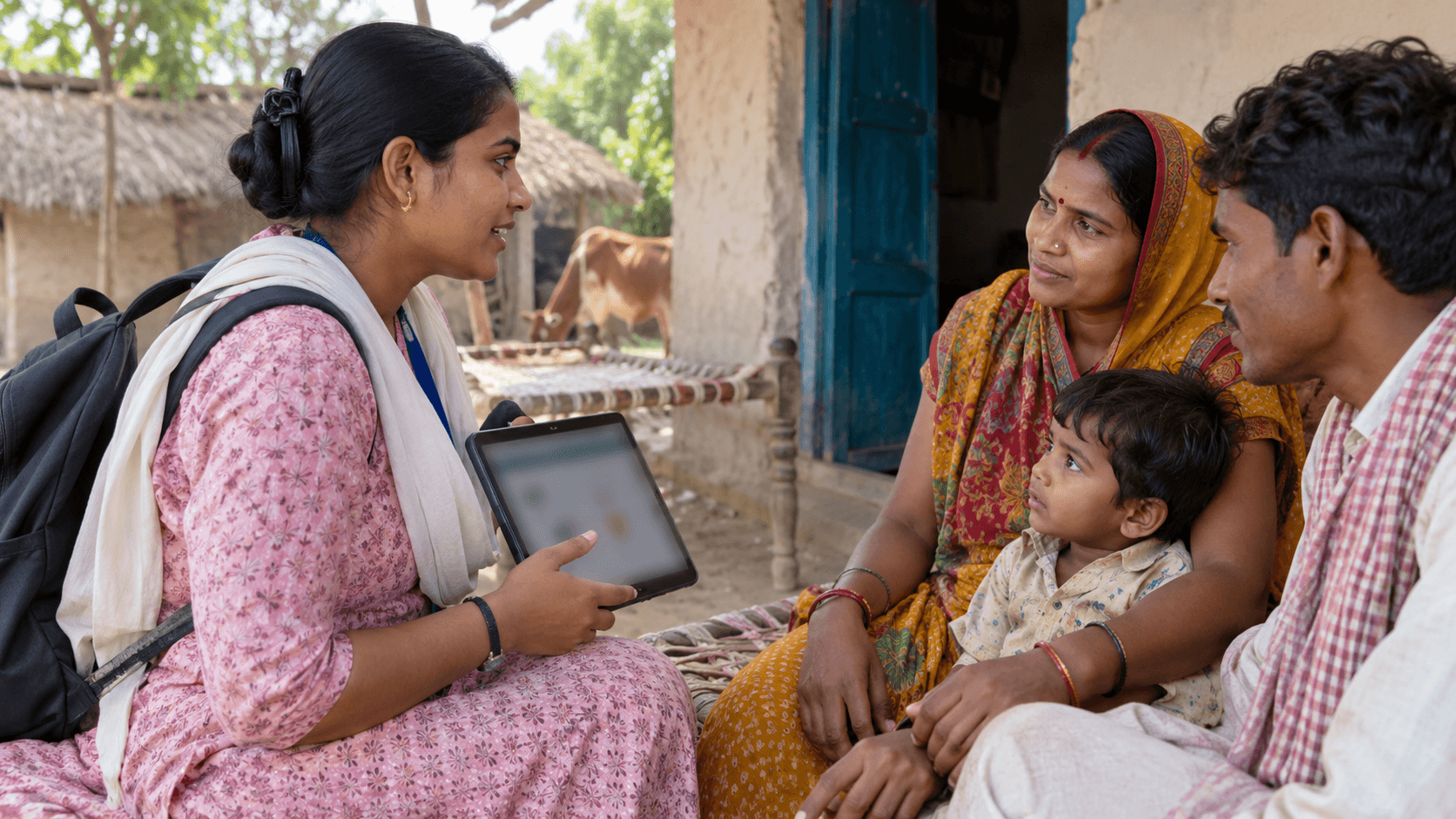


A field worker completes three household visits where the mobile signal is weak. The app says “saved”, but two records never reach the supervisor. A fourth visit is then scheduled from an old list. For community health work, an offline app must answer two questions plainly: what was recorded, and what still needs to sync?
India's National Health Mission 2026 operational guidance describes an offline-enabled home-visit tool that follows approved visit formats and syncs when connectivity returns. The product lesson is to build around programme rules and staff practice, not invent a clinical checklist in software.
Start with the approved visit flow
Map who schedules a visit, which household or person is eligible, what form the worker is authorised to complete and what follow-up can be assigned. Keep identifiers stable even if two workers visit the same family on different days. A household record, a person record and a visit record serve different purposes; merging them into one long form makes duplicate and follow-up problems harder to solve.
The health programme's clinical lead should own the questions, warning signs and referral rules. A developer can make the form easier to use, but should not create or change clinical thresholds from guesswork. Show required fields in the context of the visit and allow a documented reason when a question cannot be answered.
Make offline state visible to workers
Save each completed form on the device with a local ID, timestamp and status such as saved locally, queued, synced or needs attention. Give the worker a count of pending records before they leave an area with connectivity. Do not display one green “done” state when the server has not acknowledged the record.
On reconnect, send records in a retry-safe way. The server should recognise the same local visit ID if the upload is repeated. If a supervisor changed a schedule while the worker was offline, do not overwrite the newer version silently. Show the conflict for review or apply a documented field-level rule. A useful test is to edit the same appointment on two devices, then sync in the reverse order.
Protect data stored on a lost phone through device-level security, encrypted storage where appropriate and short, role-based sessions. Minimise information cached on the device. A field worker should not need a complete district-wide dataset to visit ten households. The OWASP authorization guidance applies when the device later requests or updates server records.
Close referrals and follow-up
A referral is not finished when the form is submitted. Record the destination, priority under the approved programme rules, contact action and whether a supervisor acknowledged it. The worker needs to see which follow-ups remain open after sync. If an urgent concern occurs without signal, the organisation needs a separate phone or in-person escalation procedure; an app notification cannot be the only safety path.
Test on a low-cost Android phone with airplane mode, full storage, a failed upload and an app restart. Measure whether any record disappears and whether the worker understands what to do next. The offline proof-of-delivery workflow covers similar sync mechanics, but community health adds sensitive data and programme-owned clinical rules.
If your outreach team duplicates paper forms because it cannot trust the app, send me an anonymised form and sync journey. I can help define the data flow and failure cases for a safer field build.
Reliable follow-up starts with a record that survives the day offline and arrives intact.


