



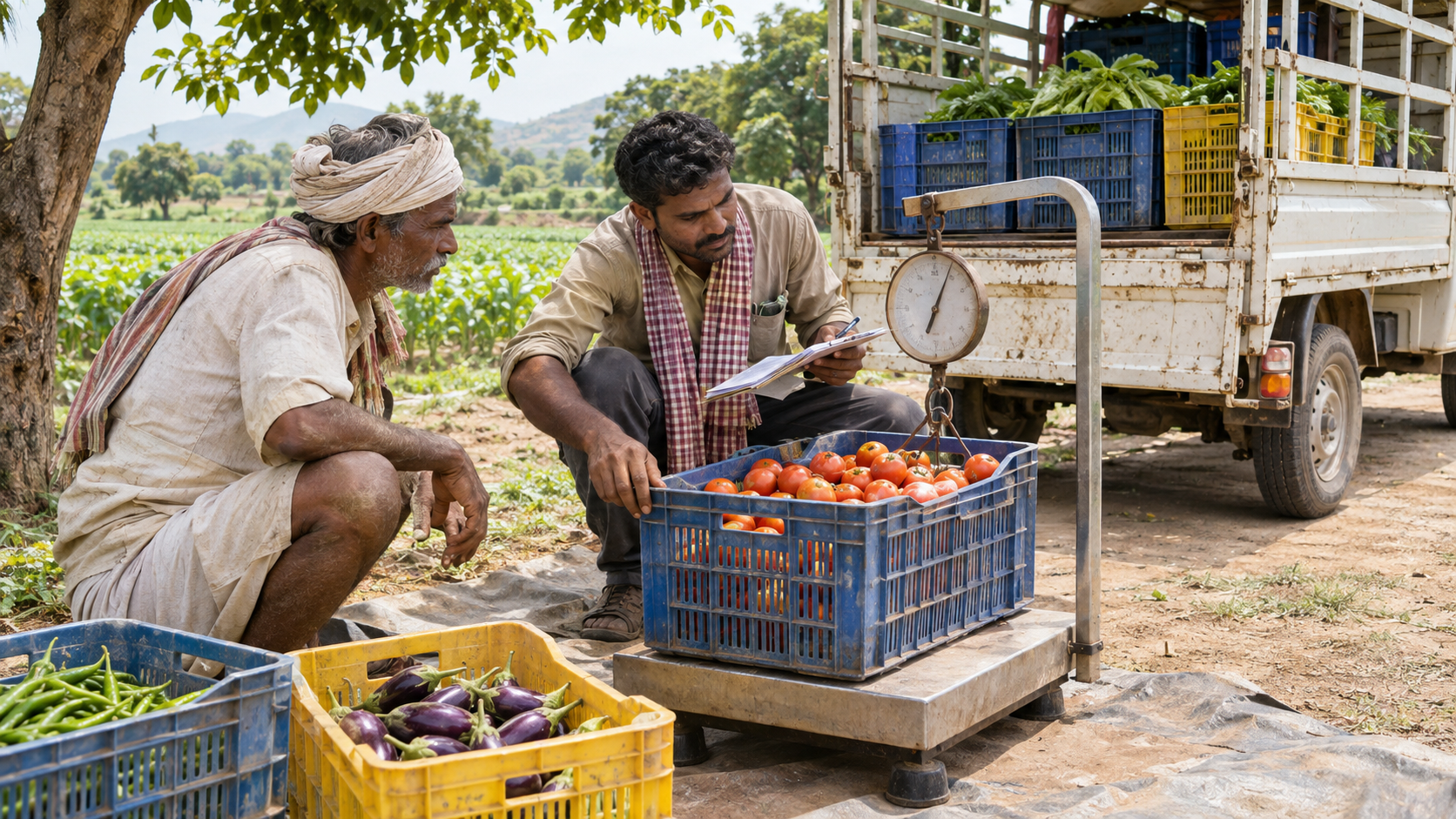


A farmer requests pickup for 200 kg of produce. The truck arrives after the produce has been sold elsewhere, or discovers 350 kg with no spare capacity. A calendar appointment alone cannot solve this problem. The request, route, measured quantity and settlement have to stay connected.
Mobile pickup models are already part of Indian agritech experimentation; the NITI Aayog compendium describes an Agrowave collection model built around mobile pickup stations. The product decision for a new operator is narrower: which facts must the farmer and field team share before a vehicle is dispatched?
Ask for an estimate, then confirm a slot
The farmer submits crop, expected quantity, village or collection point, preferred window and a contact number. Label quantity as an estimate. A dispatcher groups nearby requests, checks vehicle capacity and confirms a realistic slot. The app should notify a farmer when timing changes and provide a simple cancellation path.
Avoid assuming every farm can be reached from a street address. Map pin, landmark and local directions may be more useful. A field agent can help enter requests where the farmer does not want an app.
Record the physical handoff
The driver marks arrival, records actual weight, and captures the grade or quality decision required by the buyer. If part of the lot is rejected, show accepted and rejected quantities separately with a reason. Issue a receipt the farmer can keep, ideally as a message or downloadable document. The system needs a correction trail: changing a weight after the receipt is issued should be visible, not a silent database edit.
Low connectivity should be treated as normal. A mobile app can store pending records locally and synchronize them once a connection returns, with clear conflict handling for duplicated pickups. Never show "payment complete" just because a pickup is complete.
Connect operations to settlement without hiding uncertainty
The price may depend on the agreed rate, grade, final weight and buyer terms. Display the calculation and payment status separately from collection status. For a pilot, start with one crop, one area and a small driver team. Test a missed slot, partial rejection and two staff members attempting the same pickup. If you are organizing produce collection through calls and spreadsheets, share the workflow with me at adityazen and I can map the app and dispatcher dashboard around the real handoffs.


