



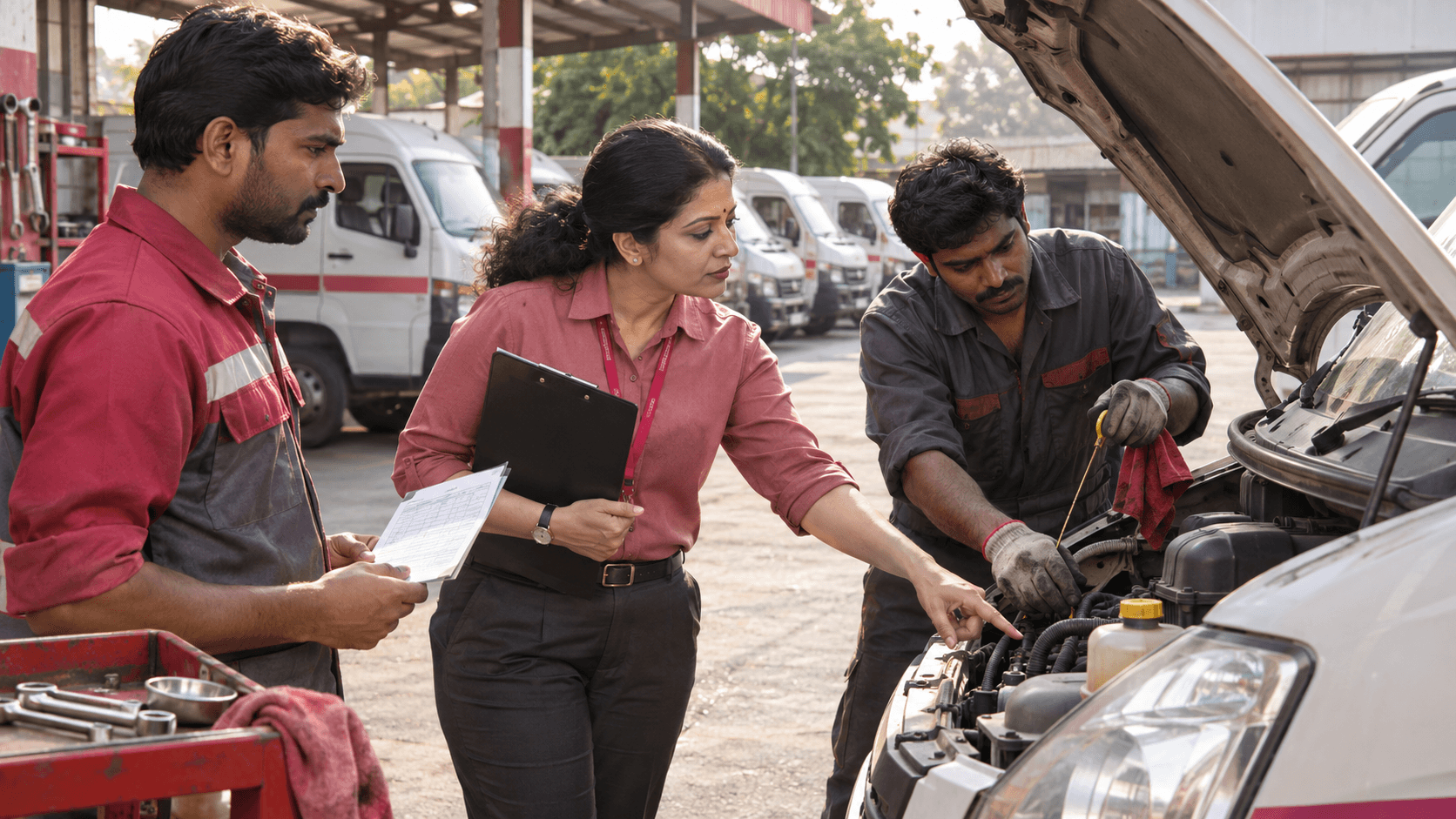


A delivery van can appear available on the dispatch board while its driver has reported a brake warning and the workshop has booked it for service. The failure is not a missing GPS dot. It is that dispatch, drivers and maintenance use different records.
For a small fleet, start with one dependable vehicle history and a simple rule for taking a vehicle out of service. Add software only where it makes that decision visible to the people who schedule work.
Build a record around each vehicle
For every van or truck, keep an internal vehicle ID, registration, make and model, responsible depot, current odometer reading, service history and the relevant documents. Record who entered each reading and when. If a driver submits a suspiciously low distance after a long route, the system should flag it for review instead of resetting the maintenance clock.
Set service triggers using the manufacturer's guidance and the operator's actual use: a date, distance or both. Tata Motors' fleet management service describes maintenance based on the operator's service book and tracking of maintenance costs. Your workshop should define the actual intervals; a website developer should not invent a universal service schedule for every vehicle.
Turn a driver report into an accountable repair job
A driver should be able to report a defect from a phone with the vehicle ID, symptom, date, optional photo and whether the vehicle can be driven safely. The responsible manager decides its status: needs inspection, scheduled repair, out of service or returned to service. A clear severity rule matters more than a long form.
The India-focused Ellibo Fleet help page shows the useful separation between an issue and a repair job. Your own process should also record who authorised a repair, which vendor did it, parts and cost, and who confirmed completion. If the defect is safety-critical, a dispatcher must see the out-of-service state before assigning the next trip.
Keep dispatch and maintenance in the same conversation
The dashboard should show due-soon services, overdue services, open defects and vehicles unavailable for tomorrow's routes. If a van is booked for a workshop slot, the dispatch schedule should not quietly assign it to a delivery. This does not require complex predictive AI. It requires the two teams to use the same vehicle status and to own the update when a repair finishes.
Store invoices and inspection notes against the vehicle. Over time, compare recurring faults and downtime by vehicle to decide whether to repair or replace it. Do not label a cost chart as “savings” unless you have a valid baseline.
When I would build a fleet workflow at adityazen, I first test the handoff from driver report to dispatch restriction and workshop closure. If that works on a phone and at a desk, the rest of the dashboard can grow around real operations.
Decide between a spreadsheet, fleet software and a custom app
A spreadsheet can work for a few vehicles if one person updates it daily and the dispatcher checks it. An established fleet platform may suit a larger mixed fleet that needs ready-made inspections, vendor records and service reminders. Custom software becomes useful when maintenance must connect to the company's existing dispatch, proof-of-delivery or finance system and off-the-shelf fields cannot represent its workflow.
Test with three cases: a routine service due tomorrow, an urgent driver defect just before a route, and a repair completed without an invoice. Ask whether the right person sees each exception and whether the vehicle can be assigned only after approval. That is a more useful acceptance test than a dashboard screenshot. For the separate field-delivery side, see my offline proof-of-delivery app guide.


