



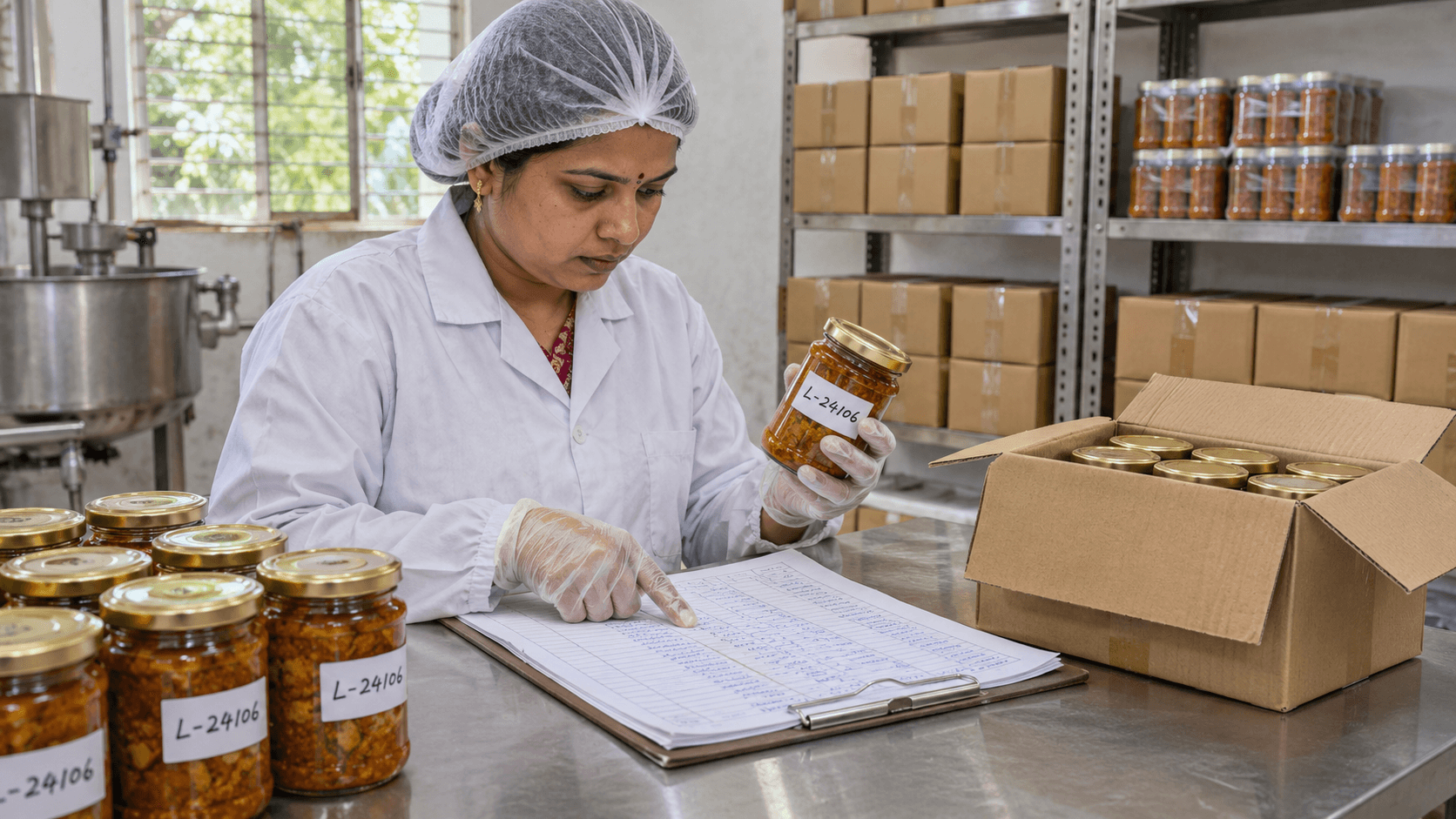


A small pickle maker receives chilli from two suppliers, cooks three batches on Tuesday and sends finished jars to five shops. On Friday, one supplier reports a problem with a particular chilli lot. Which jars contain it, where did those jars go, and how many remain in the warehouse?
That question is hard to answer from a sales invoice alone. The useful unit of information is the lot relationship: input lots used in a production run, finished batches created by that run, and cartons dispatched from each finished batch. The FSSAI food recall regulations identify lot and batch details among the distribution records food businesses need to maintain. This article focuses on designing an operational record; a food-safety professional should assess the business's specific legal and handling obligations.
Give every handoff an identifier
At receipt, record the supplier, ingredient, supplier lot, date, received quantity, unit and internal receipt ID. Do not collapse two deliveries of the same ingredient into one anonymous stock balance. A supplier may use one lot number across several deliveries; a processor can still preserve each receipt and link it to that lot.
For each production run, record the recipe version, start date, operator, input receipt IDs and quantities actually consumed. Assign a finished-batch ID to the output and capture pack size, number of units, manufacturing and expiry details where applicable. The label on each jar or carton must match the recorded batch ID. If labels are reprinted, keep the approved label version with the run rather than relying on memory.
At dispatch, record the finished batch, quantity, customer or distributor, delivery date and invoice or delivery reference. If a shipment mixes two batches, split its line items by batch. A single invoice number can still have two distinct batch lines. This is what lets a team contact only the affected destinations instead of treating every jar sold that month as suspect.
Walk the records in both directions
Start with a supplier lot and trace forward: which runs used it, which finished batches came from those runs, which cartons are still on site, and which customers received the rest? Then pick a finished jar and trace backward: which production run, ingredient receipts and supplier lots contributed to it? FSSAI's recall guidance describes a lot-specific distribution list and reconciling recovered quantities, which makes this exercise more than an inventory count.
For example, suppose run P-042 used chilli lot C-18 and produced 240 jars. Warehouse staff still hold 30; four shops received 40 each; one distributor received 50. The record accounts for 240 jars. If the numbers add up to 230, the missing ten are an investigation, not a spreadsheet cell to adjust silently. Record whether they were samples, damaged jars, a counting mistake or an unrecorded dispatch.
Keep returned or held stock separate from sellable stock. A status such as “on hold” must stop both counter sales and website availability for the affected batch. My POS and WooCommerce stock-sync guide covers channel availability; batch status provides the more precise rule for products that cannot be sold.
Test the process before buying software
Take one real ingredient lot and perform a timed paper exercise with production, packing and sales staff. Can they find all finished batches and destinations without reconstructing WhatsApp messages? Do they know who can correct a mistaken quantity? Can they show the original value and the correction? If a distributor split a shipment onward, is there an agreed way to request its downstream list?
A small unit with one production line may start with protected spreadsheets and disciplined labels. A custom app becomes useful when several people record receipts, runs and dispatches at different times, or when a product can be traced only by joining multiple ledgers. In that case I would model receipts, production runs, batch allocations and shipment lines as separate records, with a change history. If your current records cannot answer the two-way trace question, show me one actual batch flow at adityazen; I can help identify the smallest useful system before proposing a larger build.
The immediate goal is a defensible answer to “where did this lot go?” Accurate identifiers and recorded handoffs matter more than a dashboard that merely shows total stock.


